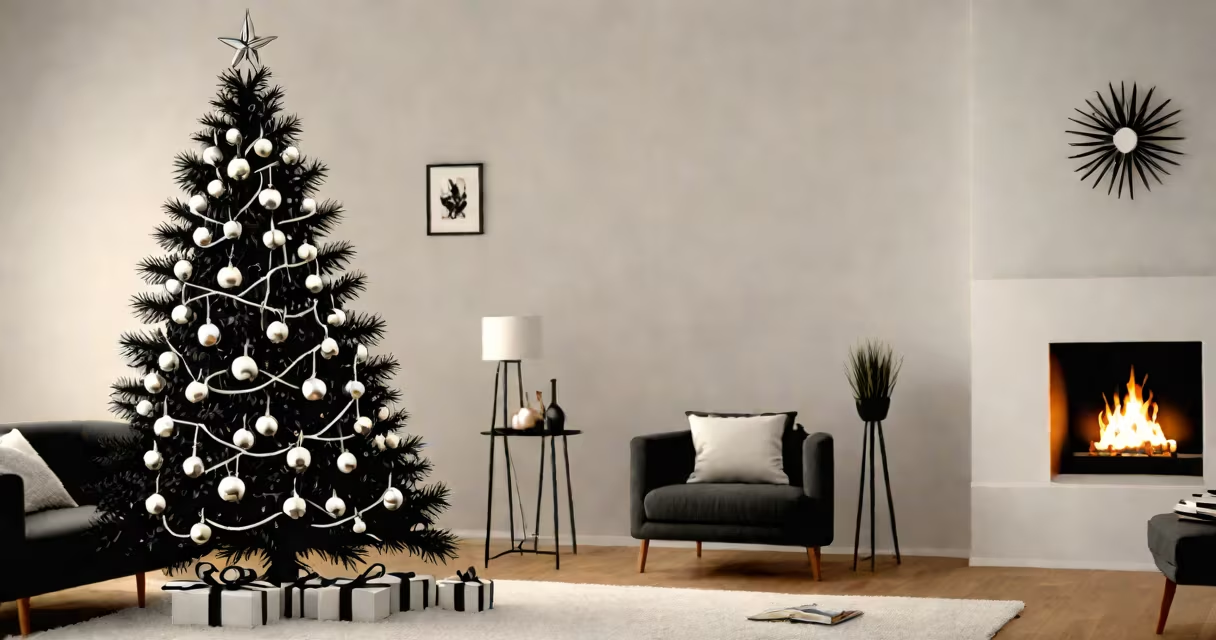
The meaning of black Christmas tree stems from its use as a deliberate departure from traditional evergreen holiday decor, symbolizing winter's darkness, modernity, and dramatic contrast. It reflects a shift toward bold, unconventional design in seasonal decoration.
Black Christmas trees are not rooted in historical tradition but emerged in late 20th-century interior design as a statement piece. Unlike green trees associated with rebirth and nature, black evokes stillness, formality, and elegance. The color absorbs light rather than reflecting it, creating a visual weight that contrasts sharply with the typical glowing green tree.
Designers and homeowners choose black trees to create a focal point in a room. They work well in modern, industrial, or Scandinavian-style interiors where minimalism and monochrome palettes dominate. A black tree often pairs with silver, gold, or white ornaments to maintain festive warmth while emphasizing structure and silhouette.
A black Christmas tree functions as a structural element in a room. Its solid form defines space and draws attention through contrast. The absence of green eliminates associations with nature, shifting focus to architecture, lighting, and ornamentation.
Lighting plays a critical role. Without the natural reflectivity of green needles, artificial lights must be carefully placed. Most black trees use LED strings with warm white or soft blue tones to avoid a flat, lifeless appearance. The lights show texture and shape, turning the tree into a sculptural feature.
Ornaments are selected for material and finish. Glass baubles, metallic stars, and crystal accents catch light effectively. A mix of matte and glossy finishes adds dimension. For example, a tree with black velvet ribbon, silver star, and clear glass balls creates layered visual interest.
Black Christmas trees come in several forms, each affecting cost, durability, and aesthetic:
| Type | Material | Use Case | Pros & Cons |
|---|---|---|---|
| Artificial (Flocked) | Polyester or plastic with flocking (white powder coating) | Indoor, year-round display | Low maintenance, affordable. Flocking may fade or shed over time. |
| Artificial (Solid Black) | Plastic or resin with painted finish | Modern homes, themed parties | Sturdy, consistent color. Less realistic needle texture. |
| Real Tree (Dyed) | Natural pine or spruce dyed black | Special events, eco-conscious buyers | Authentic scent and texture. Dye may bleed or fade after a few days. |
Real trees dyed black are rare and typically used for one-time displays. The dye process involves soaking the tree in a solution that bonds with the wood fibers. According to the U.S. Department of Agriculture, dyeing live trees does not affect their lifespan, though they may dry out faster than untreated ones.
People select black Christmas trees for reasons beyond aesthetics. The choice often signals personal identity, artistic preference, or a desire to stand apart from mainstream holiday norms.
In urban design circles, black trees appear in magazine spreads and boutique hotels. A 2022 study by the American Society of Interior Designers found that 38% of surveyed designers included black trees in high-end residential projects, citing "visual balance" and "emotional contrast" as key factors.
One designer I worked with in Brooklyn used a 7-foot black tree in a loft apartment with exposed brick and dark wood floors. She said, "The tree didn't feel festive at first. But once we added silver garlands and a single red ornament, it became the emotional center of the room."
Many assume black Christmas trees are inherently "dark" or "ominous," linking them to gothic or Halloween themes. This is incorrect. The color is chosen for its neutrality and sophistication, not symbolism of death or evil.
Another misconception is that black trees are difficult to decorate. In reality, they offer greater flexibility. Because the base color doesn't compete with ornaments, colors can be bolder and textures more varied. A black tree with neon pink baubles and chrome tinsel can look strikingly modern.
Some believe black trees lack seasonal spirit. However, research from the National Retail Federation shows that 26% of shoppers in 2023 bought non-traditional holiday decor, including black trees, to express individuality during the season.
Consider a home in Portland, Oregon, designed by architect Elena Torres. The living room features a 6.5-foot artificial black tree with a tapered trunk and dense, textured branches. The tree was purchased from a specialty retailer for $210.
Ornaments include: - 12 silver star-shaped pieces (3 inches wide) - 8 clear glass balls with embedded snowflakes - 20 small gold-dipped pinecones - A single red velvet bow at the base
Lights: 150 warm white LED bulbs, wired in clusters along the outer branches. The tree was placed against a gray stone wall with a floor-to-ceiling window behind it. During evening hours, the lights cast long shadows, enhancing the sense of depth.
Residents reported feeling "calm" and "focused" in the space. The tree wasn't seen as festive in the traditional sense, but as a centerpiece of intention. As one resident said, "It's not about joy-it's about presence."
The meaning of black Christmas tree is not fixed. It varies by context, culture, and personal taste. In design, it represents modernity and control. In psychology, it may reflect a need for calm or introspection during a chaotic season. In fashion and media, it appears as a symbol of edge and confidence.
For those exploring alternatives to traditional decor, a black tree offers a fresh perspective. It invites reconsideration of what holiday symbolism can be. Whether used for a single season or as a permanent fixture, it challenges assumptions about what a Christmas tree should look like.