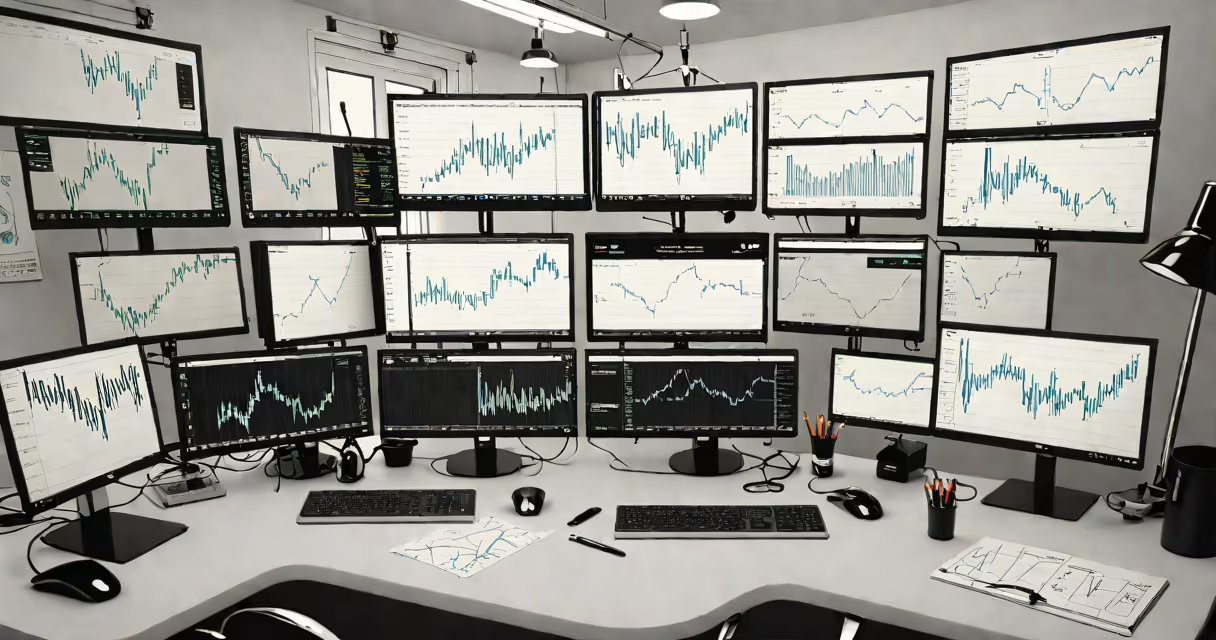
Only prop firms are financial institutions that supply traders with capital to execute trades using their own strategies, retaining ownership of the account and profits while sharing risk and rewards based on performance. These firms operate exclusively with proprietary capital, not client funds, and focus on high-frequency or directional trading across equities, forex, futures, and commodities.
Unlike banks or asset managers, only prop firms don't manage money for external investors. Instead, they vet individual traders through rigorous evaluation processes. Traders receive access to substantial capital-often $100,000 to $1 million-based on demonstrated consistency and risk control. Profits are split between the trader and the firm, typically on a 70/30 or 60/40 basis, depending on the firm's model and the trader's track record.
These firms emerged in the 1980s as a response to increasing regulatory scrutiny of bank proprietary desks. Today, they serve as a critical bridge between retail traders and institutional-grade liquidity, offering structured pathways for skilled individuals to scale their trading careers without raising private capital.
Only prop firms operate under a performance-based funding model. A trader applies to join a firm's program, often through a web portal. The application includes a review of past trading history, strategy documentation, and sometimes a live evaluation phase.
During the evaluation, the trader manages a simulated or real account with a set amount of capital-commonly $10,000 to $50,000-over a period ranging from 1 to 4 weeks. The firm sets specific targets: minimum profit threshold (e.g., 5% return), maximum drawdown limit (e.g., -10%), and position size constraints. Failure to meet any condition results in rejection.
If successful, the trader advances to a funded account. The firm allocates capital-say, $250,000-under predefined rules. The trader executes trades, and the firm tracks metrics such as daily P&L, Sharpe ratio, and max drawdown. After a set period (usually 3-6 months), the firm reviews performance and may increase capital allocation or offer a permanent partnership.
Only prop firms vary by structure, capital size, and focus. The most common models include:
| Type | Capital Range | Focus | Profit Split | Example Firm |
|---|---|---|---|---|
| High-Frequency Trading (HFT) | $500K-$5M+ | Algorithmic trading, microsecond latency arbitrage | 70/30 (firm/trader) | Jump Trading |
| Directional & Volatility | $100K-$1M | Forex, futures, options; trend-following or mean-reversion | 60/40 | Topstep |
| Multi-Asset Specialized | $250K-$2M | Commodities, crypto, indices; hybrid strategies | 70/30 | FTMO |
Some firms require traders to work remotely from approved locations. Others mandate the use of specific platforms like MetaTrader 4, NinjaTrader, or proprietary systems. Compliance monitoring is strict-firms track trades in real time, flagging excessive risk-taking or violations of position limits.
A lesser-known fact: many only prop firms use internal risk scoring systems that assign a "risk grade" to each trader based on volatility, frequency, and loss patterns. This score determines whether a trader qualifies for higher capital tiers. For example, FTMO uses a Risk Score Index (RSI) that adjusts funding levels dynamically based on behavior.
Only prop firms are frequently confused with hedge funds, venture capital firms, or even online trading schools. But they differ fundamentally in purpose and structure.
Hedge funds pool investor capital and charge management fees and performance bonuses. They report to regulators like the SEC and file Form PF. Only prop firms do not raise capital from external sources-they use their own balance sheets. They don't pay performance fees; instead, they take a share of profits directly from the trading account.
Another misconception: only prop firms aren't "free" to join. While some advertise "no-cost trials," the evaluation phase still requires a significant time investment. Many firms charge a non-refundable fee-typically $100 to $500-for access to the assessment process. Topstep charges $199 for its initial evaluation tier.
Also, unlike online brokerages, only prop firms don't allow traders to withdraw funds during the evaluation. Profits are locked until the trial ends. Some firms even restrict the use of certain indicators or automated scripts during testing.
In 2022, a freelance software developer from Austin applied to FTMO's Pro Challenge. He had traded forex for five years using a mean-reversion strategy on EUR/USD and GBP/USD pairs.
He began with a $10,000 evaluation account. Over 30 days, he achieved a 12.4% return with a maximum drawdown of -7.2%. His average daily turnover was $150,000, and he held no positions longer than 4 hours. FTMO's algorithm flagged only two minor rule violations related to trade timing.
After passing, he received a $250,000 funded account. Over the next 90 days, he generated $48,000 in net profits. FTMO paid him $28,800 (60%) and increased his capital to $500,000. By month six, he was promoted to the Platinum Tier with $1M in capital and a 70/30 profit split.
This path reflects the typical progression: consistent performance leads to scaling. The firm benefits from low-risk capital deployment, and the trader gains access to resources that would otherwise be unattainable.
I once observed a live FTMO evaluation session at a trading conference in Miami. A participant traded gold futures using a breakout strategy. On Day 14, he hit a 10% drawdown due to a sudden market gap. The system auto-flagged the breach, and he lost eligibility.
That moment revealed a core truth: only prop firms prioritize risk control over profit chasing. They're not interested in "winning big"-they want traders who can preserve capital. A single bad trade can end a career, even if the strategy is sound.
According to the Commodity Futures Trading Commission (CFTC), over 60% of traders fail the initial evaluation phase at major only prop firms. The failure rate drops to below 15% after the first funded account, indicating that only disciplined, repeatable strategies succeed long-term.
For traders seeking institutional-grade opportunities without the overhead of launching a fund, only prop firms offer a viable alternative. They're not for everyone-but for those who master discipline, risk management, and consistency, they represent a direct path to professional trading.
Understanding how only prop firms function reveals a different model of finance-one rooted in performance, not connections. If you're considering joining one, study the rules, simulate your strategy under pressure, and prepare for a rigorous test of skill and temperament. Success isn't guaranteed, but the structure is clear.