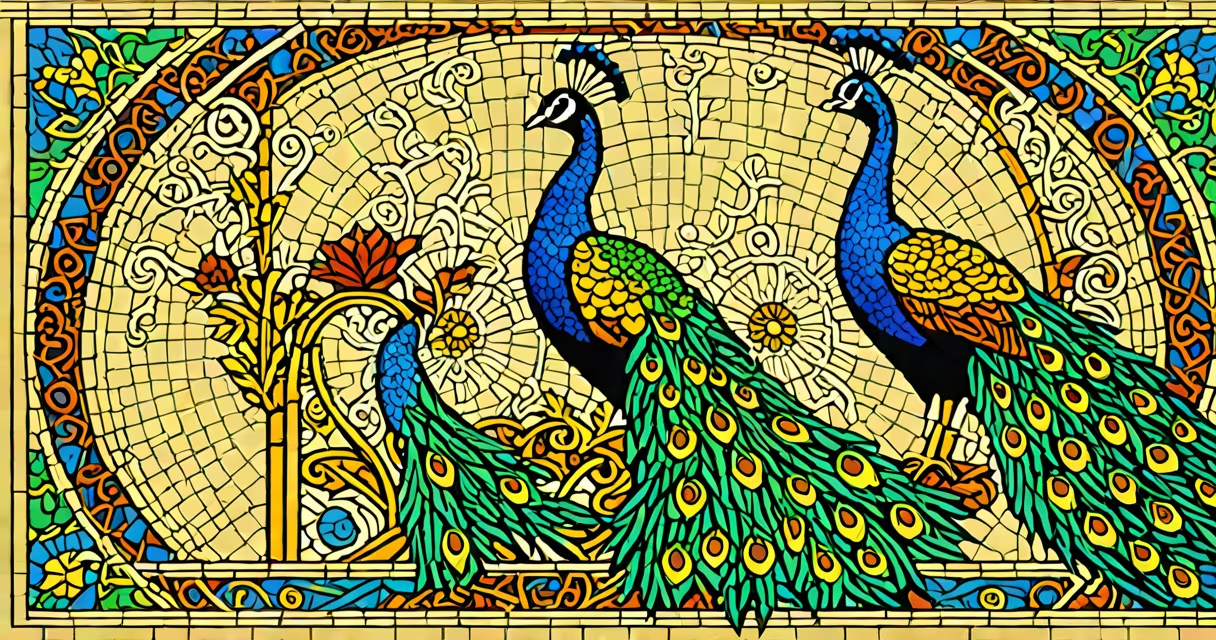
The peacock in Christianity symbolizes resurrection, eternal life, and divine beauty. Its iridescent feathers were interpreted by early theologians as representing incorruptibility and the soul's immortality. This symbolism emerged in the 3rd century and persisted through medieval art and liturgical tradition.
Early Christian writers such as St. Augustine and St. John Chrysostom associated the peacock with Christ's victory over death. They believed the bird's flesh did not decay after death-a mythic trait that mirrored the belief in bodily resurrection. In the Eastern Orthodox tradition, the peacock became a visual metaphor for the eternal nature of the soul, especially during Lenten and Easter cycles.
Artistic depictions of the peacock appear in mosaics, frescoes, and illuminated manuscripts. The Basilica of San Vitale in Ravenna (6th century) features peacocks in the apse, their feathers arranged to form a halo-like pattern around Christ. These images were not decorative-they carried doctrinal weight. The peacock's tail, with its eye-like patterns, was seen as a representation of God's all-seeing presence.
Christian interpretation of the peacock evolved from Greco-Roman traditions. In ancient Persia and Greece, the bird was linked to royalty, protection, and the goddess Hera. When Christianity spread into the Roman Empire, these existing associations were reinterpreted. The peacock's association with vigilance and watchfulness aligned with Christian ideals of spiritual awareness.
By the 4th century, the peacock began appearing in catacomb art. A fresco in the Catacomb of Priscilla shows a peacock near a cross, its feathers forming a protective arc. Scholars at the Vatican's Dicastery for Promoting Christian Unity note that such imagery served as a silent catechism for illiterate believers.
During the Byzantine period, the peacock was integrated into liturgical vestments. Bishops wore robes embroidered with peacock motifs during Easter services. The color blue in these designs represented heaven, while the green feathers stood for renewal. This practice continued in Armenian and Coptic Christian communities into the 19th century.
Peacocks appear in Christian art in several distinct forms, each carrying symbolic nuance:
| Form | Description | Symbolic Meaning |
|---|---|---|
| Full bird | Peacock depicted in profile, wings spread, feathers fanned out | Resurrection, divine glory, Christ's return |
| Feather motif | Individual feathers arranged in circular or radial patterns | Eternal life, God's omniscience, the Trinity |
| Peacock head | Only the head and neck shown, often facing forward | Vigilance, spiritual awakening, the Second Coming |
These forms were not arbitrary. In the 12th-century manuscript *The Hours of Catherine of Siena*, the peacock appears in a marginal illustration with eyes on its feathers. The artist used this detail to emphasize the idea that "God sees all."
Many assume the peacock's symbolism stems from its beauty alone. But scholars at the University of Oxford's Faculty of Theology clarify that the bird's perceived incorruptibility was the core theological driver. The myth that peacocks do not rot after death-though biologically false-was central to early Christian allegory.
Another misconception is that the peacock was universally accepted in Christian doctrine. In fact, the Council of Trent (1545-1563) discouraged excessive use of animal symbols in liturgy. Some Protestant reformers rejected peacock imagery as too ornate or pagan-influenced. Martin Luther reportedly called the bird "a distraction from Scripture."
A lesser-known fact: the peacock was sometimes used as a warning symbol. In 14th-century German woodcuts, peacocks appeared beside scenes of moral failure. Their beauty contrasted with the sin they represented-suggesting that external splendor could mask inner corruption.
One of the most detailed examples of peacock symbolism is the "Peacock Window" in the north transept of Chartres Cathedral (built 1194-1220). The stained glass depicts a peacock with its tail fanned, each feather inscribed with Latin text from Psalm 103: "Bless the Lord, O my soul."
The window's design uses 13 colors, including ultramarine and gold leaf. The peacock's head faces east-the direction of Christ's coming. The feathers are arranged in a spiral, mimicking the movement of time and eternity. According to the cathedral's conservation team, the window was restored in 1998 using original pigment analysis from 13th-century fragments.
Visitors who view the window during sunrise report seeing the feathers reflect light in shifting patterns. This effect was intentional: the designers wanted the image to change with the sun, symbolizing God's presence as changing and ever-renewing.
While the peacock shares themes with other Christian symbols-like the dove (peace), the lamb (sacrifice), and the fish (Christ)-its uniqueness lies in its dual role: both aesthetic and doctrinal. Unlike the dove, which is passive, the peacock is radiant and assertive. It does not represent humility-it embodies triumph.
Compared to the phoenix (a pagan symbol of rebirth), the peacock is not tied to fire or destruction. Instead, it reflects a gentle, enduring renewal. The phoenix rises from ashes; the peacock simply remains, its feathers unchanged. This difference underscores a key Christian belief: resurrection is not annihilation followed by rebirth, but continuity of the soul.
I once visited the Church of Sainte-Marie-Madeleine in Vézelay, France, where a 12th-century relief shows a peacock standing on a tomb. The bird's head is turned toward the sky, and its feathers form a crown-like shape. I asked the priest why the peacock was included. He said, "Because Christ didn't just rise-he returned in glory." That moment clarified the deeper meaning behind the image.
Peacock symbolism in Christianity endures not because of its beauty, but because of its layered meaning. It stands as a bridge between visible creation and invisible faith-between the material world and the promise of eternal life.