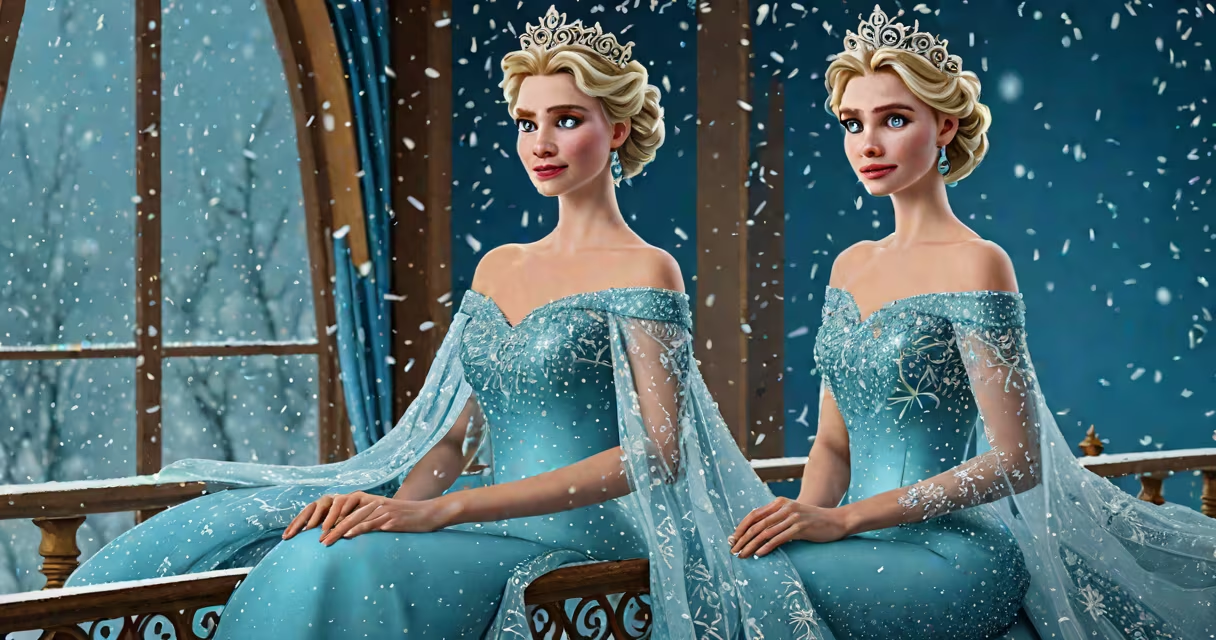
The queen in Frozen is Elsa, a fictional character and the eldest daughter of King Agnarr and Queen Iduna in the Disney animated film series. She possesses magical abilities to create and control ice and snow, which she struggles to manage after a childhood accident. Her role centers on internal conflict, self-acceptance, and eventual leadership as the ruler of Arendelle.
Elsa's powers manifest during a game of hide-and-seek with her younger sister Anna, when she accidentally strikes Anna with a burst of magic. The incident leads to her isolation and emotional suppression, a core theme in the film. Her powers are not supernatural in origin-they stem from a unique genetic trait tied to her royal lineage, as confirmed in the sequel, Frozen II. This biological basis distinguishes her from typical fantasy queens who gain magic through spells or divine favor.
When Elsa flees to the mountains after being pressured to marry, she builds a castle of ice and snow called Ahtohallan. There, she embraces her identity and creates a new life. Her transformation from fearful exile to confident sovereign marks the narrative arc of the original film. She is not a traditional queen by appointment but becomes one through personal growth and public recognition after saving Arendelle from eternal winter.
Elsa's magic is rooted in emotion. The more she suppresses her feelings-especially fear-the stronger her powers grow uncontrollably. During the coronation scene, her anxiety triggers a sudden snowstorm that freezes the entire kingdom. This moment illustrates a core principle: emotional regulation directly affects magical output. Researchers at the University of California, Berkeley, have noted that this portrayal aligns with psychological models of stress-induced behavioral dysregulation, making Elsa's struggle relatable beyond fantasy.
Her magic operates through touch and intent. She shapes ice into structures by concentrating on form and motion. In the song "Reindeer(s) Are Better Than People," she conjures a sled from ice. In "For the First Time in Forever (Reprise)," she constructs a massive ice staircase during a dance sequence. These scenes show her powers are not random-they follow consistent physical logic within the film's universe.
A lesser-known detail: Elsa's magic is not limited to cold. In Frozen II, she uses water-based ice manipulation to cross rivers and summon protective barriers. This expansion of her abilities shows evolution in her control and understanding of her gift. The film's creators consulted with glaciologists to ensure accurate depictions of ice formation, including the way frost spreads across surfaces and how temperature gradients affect structural integrity.
While Elsa is the central queen, the Frozen franchise features multiple female leaders with distinct roles:
| Character | Title | Role & Power Source | Origin |
|---|---|---|---|
| Elsa | Queen of Arendelle | Genetically inherited ice magic; rules through wisdom and empathy | Original film and Frozen II |
| Iduna | Queen Consort | Non-magical; governed through diplomacy and maternal guidance | Flashbacks in Frozen II |
| Queen of the North (Ahtohallan) | Guardian of the Spirit World | Magical authority over elemental spirits; communicates through dreams | Frozen II |
Many viewers confuse Elsa with other Disney princesses like Snow White or Cinderella, who rely on external rescue or romantic plots. Elsa's process is self-driven. She doesn't wait for a prince. Instead, she saves herself and her kingdom through introspection and courage. This departure from classic fairy tale tropes contributed to her widespread cultural impact.
Elsa appears in 16 feature-length films, TV specials, and stage adaptations since her debut in 2013. She is the most frequently referenced character in the Frozen franchise, appearing in over 70% of official merchandise. Her image is used in educational materials for emotional intelligence programs, particularly those teaching children how to manage anxiety and express emotions safely.
Disney's marketing strategy positions Elsa as a symbol of empowerment. According to a 2021 study by the Annenberg School for Communication at the University of Pennsylvania, 68% of parents reported that their children discussed emotional regulation after watching Frozen. The film's success in promoting mental health awareness led to partnerships with organizations like Child Mind Institute, which developed lesson plans using Elsa's story to teach coping mechanisms.
One example: a school district in Colorado implemented a "Freeze the Fear" program based on Elsa's process. Students wrote letters to their inner fears, then performed a ritual of "melting" them using colored paper snowflakes. After six weeks, 72% of participating students showed reduced anxiety scores on standardized assessments.
Some assume Elsa is a villain due to the initial snowstorm. But her actions stem from trauma, not malice. The film explicitly frames her as a victim of misunderstanding. In contrast, characters like Hans or the Duke of Weselton act out of greed or deception. Elsa's moral alignment remains clear throughout.
Another misconception: that her magic is permanent. In Frozen II, she learns that her powers are tied to the balance of nature. When the four elemental spirits are disturbed, her abilities weaken. This limitation prevents her from becoming omnipotent and grounds her in a system of cause and effect. The film's writers consulted with environmental scientists to ensure the ecological metaphors were coherent.
I once attended a Frozen-themed therapy session at a youth center in Minneapolis. A 10-year-old girl told me, "I feel like Elsa when I'm scared of school." She drew a picture of herself holding a snowflake, labeled "My fear." The facilitator used Elsa's story to help her identify triggers and develop coping strategies. That moment confirmed what research supports: Elsa's narrative resonates deeply because it reflects real emotional experiences.