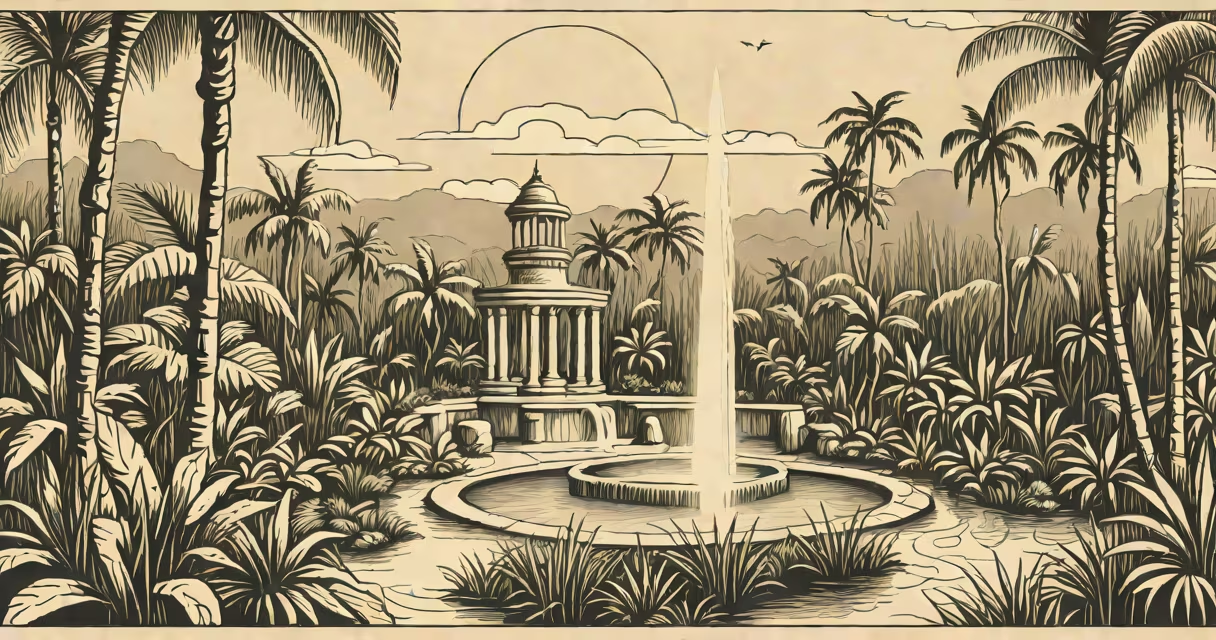
The fountain of youth is a mythical spring believed to restore youth to anyone who drinks from it or bathes in its waters. This legend dates back to early European folklore and has persisted through centuries as a symbol of eternal life and rejuvenation.
According to myth, the fountain appears in remote, hidden locations-often guarded by nature spirits or placed beyond treacherous terrain. Its waters are described as shimmering, warm, and emitting a faint golden light. The idea is not just about physical renewal but also about reversing time's effects on the mind and spirit.
Historical references to the fountain appear in texts from the 15th century onward. Spanish explorer Juan Ponce de León is most famously linked to the legend, though he never documented seeking such a spring. His 1513 expedition to Florida was officially aimed at claiming land, but later accounts painted him as chasing a mythical source of eternal youth. The National Park Service confirms that while Ponce de León did explore Florida, no evidence exists that he searched for the fountain.
The concept of a restorative water source predates Ponce de León. Ancient Greeks told of the River Lethe, which erased memory, and the Hippocratic tradition emphasized healing waters. In medieval Europe, alchemists sought elixirs of life, believing certain mineral springs held major power. These ideas merged into the idea of a single, miraculous fountain.
By the 16th century, the fountain became a literary device. Writers like Sir Thomas More and Miguel de Cervantes used it to critique human ambition. In More's *Utopia*, characters debate whether eternal life would be desirable-or merely a burden. Cervantes' *Don Quixote* mocks those who chase impossible dreams, including the search for the fountain.
A lesser-known fact: the Latin term *fons vitae*, meaning "spring of life," appears in early Christian writings. Some scholars suggest the fountain may have roots in religious symbolism-particularly the biblical Garden of Eden and the Tree of Life. The idea of a sacred water source that grants eternal life echoes both Jewish and Christian traditions.
The fountain of youth appears in many forms across cultures. While often associated with Western mythology, similar concepts exist globally:
| Culture/Region | Variant Name | Key Features |
|---|---|---|
| Spanish | Fuente de la Juventud | Linked to Ponce de León's Florida voyage; depicted as a hidden spring in jungle terrain. |
| Japanese | Yōkai no Mizu (spirit water) | Believed to flow from mountain shrines; consumed during festivals to cleanse aging spirits. |
| West African (Yoruba) | Ọlọrun's Pool | Located beneath a sacred baobab tree; said to grant wisdom and vitality to those deemed worthy. |
| Scandinavian | Odin's Well | Not a literal fountain, but a metaphor for divine knowledge; drinking from it brings insight, not youth. |
These variants differ in location, guardianship, and required rituals. For example, in Japanese tradition, one must purify oneself through ritual bathing before approaching the water. In Yoruba belief, access is granted only after spiritual trials. The Spanish version remains the most widely recognized due to its association with exploration and colonial narratives.
Many assume the fountain of youth was a real place or that Ponce de León actually searched for it. Historical records show he was motivated by territorial expansion, not immortality. The connection between him and the fountain emerged decades after his death, shaped by popular storytelling and national mythmaking.
Another misconception is that the fountain restores youth indefinitely. Most versions imply a temporary effect-bathing once renews age by ten years, but repeated use leads to diminishing returns. Some tales even warn that excessive use causes mental instability or physical decay, suggesting the pursuit of eternal youth comes with hidden costs.
Modern science has debunked the idea of a biological fountain. According to the National Institute on Aging, aging results from cellular damage, telomere shortening, and accumulated metabolic waste-not lack of magical water. However, research into longevity continues. A 2023 study published in *Nature Aging* found that partial reversal of cellular aging is possible using gene therapy in mice-but no human trial has yet produced results resembling the fountain's effects.
The fountain of youth persists because it represents a universal desire: to escape decline. It appears in films like *Pirates of the Caribbean: On Stranger Tides*, where a character seeks the fountain to survive a fatal wound. In literature, it surfaces in novels like *The Time Traveler's Wife*, where the protagonist's wife ages normally while he moves through time.
I once visited a small museum in St. Augustine, Florida, home to a replica of a 16th-century ship's log that mentions Ponce de León's process. There, a plaque read: "He sought land, not life." That moment clarified something essential-the fountain isn't about water. It's about longing. The search itself becomes the story.
Today, the phrase "fountain of youth" is used metaphorically. Companies market anti-aging products with the slogan "Find your fountain." Fitness studios advertise "rejuvenation circuits." Even social media influencers promote "youth rituals" involving cold plunges and fasting. These are not literal fountains, but they tap into the same psychological pull-the hope of reversing time.
The fountain of youth remains a useful symbol. It is not a place, nor a substance. It is a mirror-showing what humans fear, desire, and imagine when they look at their own mortality.