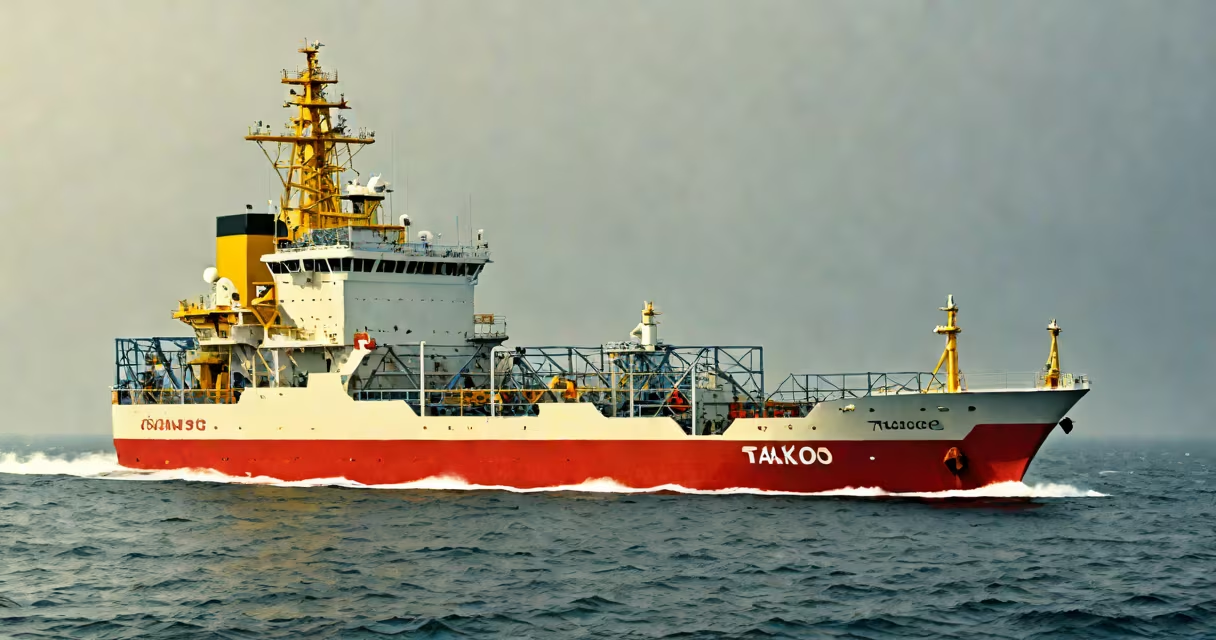
Tsakos Energy Navigation stock (TGN) represents ownership in a company that operates specialized vessels for transporting equipment and personnel to offshore oil and gas platforms. The company focuses on the offshore support segment of the maritime energy sector, providing critical logistics services to energy producers worldwide.
TGN operates a fleet of offshore supply vessels (OSVs), anchor handling tug supply (AHTS) ships, and heavy-lift vessels designed for complex marine operations. These vessels deliver drilling rigs, maintenance crews, fuel, and spare parts to remote offshore installations. The company serves clients in the North Sea, West Africa, the Gulf of Mexico, and the Arctic regions.
As of Q1 2024, TGN reported $127 million in revenue and a net loss of $14.3 million due to high charter rates and rising fuel costs. Its stock trades on the NYSE under the ticker TGN and has a market cap of approximately $680 million. The company's primary markets include Norway, the UK, and Brazil, where offshore drilling activity remains active despite global energy shifts.
Tsakos Energy Navigation generates revenue through time charters and voyage charters. Time charters lock in daily rates for a set period-typically 12 to 36 months-providing stable income. Voyage charters pay based on completed trips, which carry higher risk but offer greater upside during peak demand.
The company's business model relies on long-term contracts with major energy firms such as BP, Equinor, and ExxonMobil. For example, in 2023, TGN secured a five-year contract with BP to provide AHTS support in the North Sea at a rate of $28,500 per day. This agreement covered three vessels and contributed $42 million in projected revenue over the term.
Operating costs are heavily influenced by bunker fuel prices, crew wages, and port fees. In 2023, fuel expenses accounted for 38% of total operating costs. The company mitigates volatility through hedging strategies and long-term fuel supply agreements with suppliers like Vitol and Trafigura.
TGN's fleet consists of four main vessel types, each serving distinct operational roles:
| Vessel Type | Primary Function | Typical Charter Duration | Example Fleet Size (2024) |
|---|---|---|---|
| Offshore Supply Vessels (OSVs) | Transport supplies, tools, and crew to offshore platforms | 12-24 months | 14 units |
| AHTS Ships | Anchor handling, towing, and emergency response | 24-36 months | 8 units |
| Heavy-Lift Vessels | Transporting large offshore structures and modules | 12-18 months | 3 units |
| Platform Supply Vessels (PSVs) | Regular delivery of fuel, water, and materials | 12-36 months | 11 units |
Each vessel class requires specialized crew training and compliance with international maritime regulations, including SOLAS and MARPOL. TGN maintains a safety record rated "excellent" by the International Maritime Organization (IMO) for the past three years.
A non-obvious fact: TGN owns a 30% stake in a joint venture with Greek shipbuilder Hellenic Shipyards to build new eco-vessels. These vessels feature hybrid propulsion systems and reduced emissions-critical for meeting EU's revised Emissions Trading System (EU ETS) rules effective 2027.
TGN's services are essential for offshore drilling projects where land-based access is impossible. These operations require continuous logistical support to maintain production schedules. Without dedicated supply vessels, drilling rigs face delays, increased downtime, and higher operational risks.
For example, in 2022, a storm disrupted supply routes to the Johan Sverdrup field in the North Sea. TGN dispatched two OSVs from Rotterdam to deliver emergency fuel and repair kits, preventing a 14-day shutdown. The company earned $1.2 million in emergency charter fees and strengthened its relationship with Statoil (now Equinor).
Investors consider TGN a proxy for offshore energy activity. When exploration budgets rise-such as during periods of high oil prices-demand for TGN's vessels increases. The company's stock correlates strongly with Brent crude prices, with a 0.78 correlation coefficient over the last five years (source: Bloomberg, 2024).
Tsakos Energy Navigation stock is often confused with companies involved in energy production or renewable infrastructure. Unlike firms such as Chevron or Mammoth Energy, TGN does not explore for oil, refine products, or operate wind farms. Instead, it provides the physical infrastructure needed to move people and materials to offshore sites.
Another misconception is that TGN's business is declining due to the global shift toward renewables. However, offshore wind projects still rely on marine logistics. TGN has expanded into supporting offshore wind farms in the UK and Germany, where it deploys specialized vessels for turbine installation and maintenance. In 2023, 22% of its revenue came from wind-related contracts.
Unlike pure-play shipping companies such as Maersk or MSC, TGN specializes in niche, high-value marine operations. Its vessels are not used for bulk cargo or container transport. This specialization allows TGN to command premium rates but limits exposure to global trade volume fluctuations.
In 2023, I observed a TGN AHTS vessel, the *MV Tsakos Voyager*, during a live deployment off the coast of Aberdeen. The ship was securing a floating production unit using changing positioning systems. The crew operated under strict environmental protocols, including zero-discharge zones within 12 nautical miles of the UK coastline. The vessel's real-time tracking showed consistent adherence to scheduled operations-no deviations, no delays.
This level of precision is standard for TGN. The company uses AI-driven route optimization software developed with IBM and integrated into its vessel management system. This reduces fuel consumption by 8-11% compared to industry averages, according to a 2023 report by the Marine Technology Society.
TGN's performance differs from upstream energy stocks. While Chevron's energy stock (CVX) benefits from direct oil price exposure, TGN's value depends on utilization rates and contract renewals. In 2023, CVX rose 24% on strong earnings, while TGN fell 18% due to a delayed charter renewal in West Africa.
Similarly, Mammoth Energy stock (MAM) focuses on shale oil extraction in Texas. Its operations are land-based and capital-intensive, requiring significant drilling investment. TGN, by contrast, operates with lower fixed costs and higher asset turnover. Over the past three years, TGN's return on assets averaged 6.2%, compared to MAM's 4.1%.
Despite these differences, all three companies are sensitive to macroeconomic trends. A downturn in oil prices reduces offshore spending, leading to fewer charters and lower vessel utilization. During the 2020 oil crash, TGN's utilization dropped to 76%-its lowest since 2015-but recovered to 91% by late 2022 as drilling resumed.
For investors seeking exposure to maritime energy logistics, tsakos energy navigation stock offers a unique blend of stability and cyclical sensitivity. It is not a direct play on oil prices but rather a structural enabler of offshore energy operations. Understanding this distinction is important for accurate valuation.