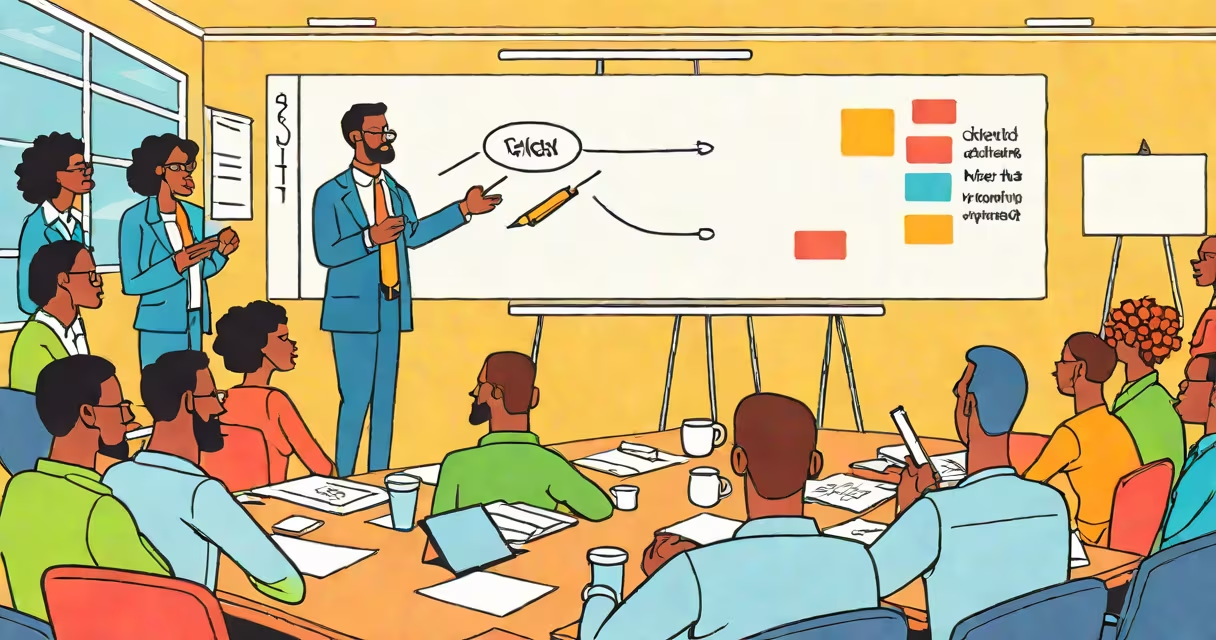
Facilitating a meeting means guiding a group through a structured conversation to achieve agreed-upon goals, using neutral oversight, active listening, and process management-not dictating content or decisions.
Facilitation is not leadership. A facilitator doesn't propose solutions or take sides. Instead, they ensure everyone's voice is heard, time is respected, and the group stays focused on objectives. This role is essential in settings requiring consensus, such as cross-functional teams, design sprints, or conflict resolution sessions.
For example, during a product launch planning session, a facilitator ensures each stakeholder-engineering, marketing, sales-gets equal time to speak. They redirect off-topic comments, summarize key points, and confirm agreement on next steps. The outcome isn't decided by the facilitator, but by the group, guided by structure.
Facilitation relies on process, not content. The facilitator manages the flow of interaction, not the subject matter. They set ground rules, clarify goals, and use techniques like round-robin sharing, silent brainstorming, or dot voting to gather input fairly.
Key actions include: checking in on group energy, naming assumptions, summarizing contributions, and identifying agreement or gaps. A skilled facilitator interrupts dominance by one person, prompts quieter members to speak, and prevents groupthink by asking "What's the opposite view?"
One technique is the "parking lot"-a visible list for ideas that don't fit the current agenda. This keeps the conversation on track while acknowledging concerns. Without it, meetings drift into tangents that waste time and frustrate participants.
Effective facilitation requires emotional intelligence, neutrality, and structured thinking. The facilitator must remain calm under pressure, manage tension, and adapt to group dynamics in real time.
Common tools include:
These tools aren't optional-they're foundational. A 2023 study by the Center for Creative Leadership found that meetings with a dedicated facilitator were 40% more likely to reach consensus than those led by a functional manager.
Not all facilitation is the same. The approach varies based on purpose and group size.
| Type | When Used | Example |
|---|---|---|
| Process-focused | Large groups needing alignment | Facilitating a town hall with 50 employees on company strategy |
| Content-focused | Expert-led sessions requiring deep discussion | Guiding a medical team through a patient care review |
| Conflict resolution | Disagreements needing mediation | Mediating between departments over budget allocation |
| Remote facilitation | Distributed teams | Running a virtual sprint planning session with participants in three time zones |
A common mistake is confusing facilitation with moderation. Moderators may control the flow of a debate but often have a stance. Facilitators remain neutral. Another error is assuming facilitation is only for large events. Even a 15-minute team sync benefits from a designated facilitator who keeps the conversation on track.
One non-obvious distinction: facilitation is not about being "nice" or making everyone happy. It's about creating conditions where difficult conversations can happen safely. A 2021 Harvard Business Review analysis showed that teams with trained facilitators reported higher psychological safety and faster decision cycles than those without.
In a real project, a software team needed to choose between two user interface designs. The engineering lead wanted the feature-rich version; the UX designer preferred simplicity. Without a facilitator, the meeting devolved into argument.
A neutral facilitator was brought in. They opened with: "Our goal is to decide which design supports both usability and technical feasibility. Let's spend five minutes each listing pros and cons."
Participants wrote notes silently. Then, each shared one point. The facilitator grouped similar ideas on a board. After 20 minutes, the group had 12 pros and 9 cons listed. The facilitator asked: "Which concerns are non-negotiable?"
Two issues emerged: load time under 2 seconds and accessibility compliance. The team then evaluated both designs against those criteria. The simpler design scored higher. The group agreed to proceed with it, with a plan to add advanced features later.
The facilitator didn't choose. They created space for clarity. The meeting ended in 45 minutes-15 under the original time limit.
Facilitating a meeting is not the same as managing it. Managers assign tasks, set priorities, and report progress. Facilitators focus on process, inclusion, and shared understanding.
It's also not the same as leading a presentation. Presenters deliver content. Facilitators draw out insights from the group. One person can do both-but only if they switch roles intentionally.
Another myth: facilitation is only for experts. In reality, anyone can learn basic facilitation skills. Training programs from the International Association of Facilitators (IAF) show that 80% of participants improved their ability to run inclusive meetings within six weeks of practice.
I once facilitated a community planning session where residents debated zoning changes. One man kept interrupting others. I paused, said, "Let's hear from someone who hasn't spoken yet," and pointed to a woman at the back. Her comment changed the direction of the conversation. That moment proved that structure, not charisma, drives results.
For more on structuring effective group interactions, explore the 10W30 structure, a method for defining meeting purposes and avoiding vague objectives.
Understanding what it means to help a meeting clarifies roles, improves outcomes, and reduces wasted time. It's not about control-it's about enabling collective intelligence.