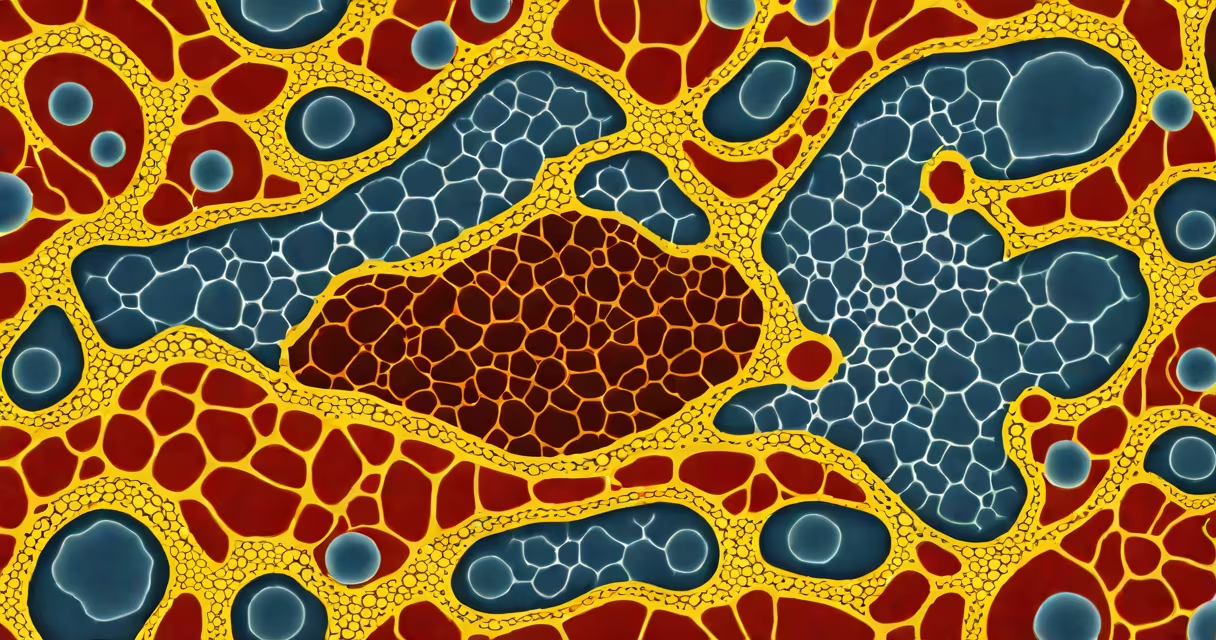
Bone marrow is the soft, spongy tissue inside bones responsible for producing all types of blood cells through a process called hematopoiesis. It maintains the body's supply of red blood cells, white blood cells, and platelets essential for oxygen delivery, infection fighting, and clotting.
Marrow functions as the central factory for blood cell formation. Within the medullary cavity of long bones like the femur and humerus, and in flat bones such as the pelvis and sternum, marrow hosts stem cells that differentiate into mature blood cells. This continuous production occurs at a rate of about 2 million cells per second in adults.
The process begins when hematopoietic stem cells (HSCs) in the marrow divide and commit to specific lineages. These precursors mature into functional cells released into the bloodstream. Without marrow activity, the body cannot sustain life-deficiencies lead to anemia, infections, and uncontrolled bleeding.
Hematopoiesis begins with multipotent hematopoietic stem cells (HSCs) residing in specialized niches within the marrow. These cells self-renew and give rise to progenitor cells that further specialize into distinct blood cell types.
Red blood cells (erythrocytes) form in response to erythropoietin, a hormone produced by the kidneys when oxygen levels drop. Each red blood cell lives about 120 days and transports oxygen from lungs to tissues. A single marrow unit can generate up to 2 × 10¹⁰ red blood cells daily.
White blood cells (leukocytes) include neutrophils, lymphocytes, monocytes, eosinophils, and basophils. Neutrophils, the most abundant, attack bacteria and fungi. Lymphocytes regulate adaptive immunity. Monocytes become macrophages in tissues. Deficiencies in these cells increase susceptibility to infections.
Platelets (thrombocytes) are fragments derived from megakaryocytes. They initiate clot formation when blood vessels are damaged. A normal platelet count ranges from 150,000 to 450,000 per microliter. Below 100,000, spontaneous bleeding becomes likely.
Bone marrow exists in two forms: red marrow and yellow marrow. Red marrow is metabolically active and responsible for blood cell production. Yellow marrow consists mostly of fat cells and stores energy, though it can revert to red marrow under stress.
| Type | Composition | Primary Function | Location in Adults |
|---|---|---|---|
| Red marrow | Stem cells, developing blood cells, fibroblasts | Hematopoiesis: makes RBCs, WBCs, platelets | Pelvis, sternum, ribs, vertebrae, proximal ends of humerus and femur |
| Yellow marrow | Adipocytes (fat cells), sparse stem cells | Energy storage, potential for conversion to red marrow | Distal shafts of long bones (e.g., femoral diaphysis) |
At birth, all marrow is red. By age 20, approximately 50% of marrow becomes yellow. This shift reflects reduced demand for blood cell production as metabolic needs stabilize. However, severe blood loss or chronic disease can trigger reversion of yellow marrow to red marrow, restoring hematopoietic capacity.
A common misconception is that yellow marrow is inactive. In reality, it serves as a reservoir for stem cells. Studies show that under conditions of extreme blood loss, yellow marrow can re-differentiate into red marrow within weeks-a survival adaptation documented in trauma patients.
Marrow failure leads to serious health consequences. Aplastic anemia results from marrow destruction, causing low counts of all blood cell types. Causes include autoimmune disorders, chemotherapy, radiation, and viral infections like Epstein-Barr.
Leukemias originate in marrow. Acute myeloid leukemia (AML) arises from abnormal proliferation of myeloid cells in red marrow. Diagnosis involves marrow aspiration and biopsy. In AML, blast cells exceed 20% of marrow nucleated cells, disrupting normal hematopoiesis.
Marrows are also critical in transplantation. Allogeneic hematopoietic stem cell transplants rely on donor marrow to reconstitute a patient's immune and blood systems. Success rates exceed 70% in matched sibling donors, according to the National Marrow Donor Program (NMDP).
During a routine marrow biopsy, doctors extract a small sample using a needle inserted into the posterior iliac crest. The procedure takes less than 15 minutes and is performed under local anesthesia. Pathologists examine the sample for cellularity, lineage distribution, and signs of infiltration by cancer or infection.
Marrow is often confused with bone itself. Bone provides structural support and calcium storage. Marrow lies within bone cavities and performs biological manufacturing. You can have healthy bone with diseased marrow, and vice versa.
Another error is assuming marrow produces only red blood cells. While red blood cell generation is important, marrow also creates immune cells and clotting agents. All three-oxygen carriers, infection fighters, and clot initiators-are equally essential.
For context, a single adult produces roughly 200 billion red blood cells each day. That's equivalent to 100 million cells per second. This volume is sustained solely by marrow activity.
When I assisted in a hematology rotation during medical school, I witnessed a patient with severe pancytopenia due to marrow suppression from chemotherapy. Blood work showed low hemoglobin, neutrophils, and platelets. A marrow biopsy revealed nearly absent cellularity. After transplant, recovery took six weeks, but marrow repopulation restored full blood counts.
Understanding marrow function is essential for diagnosing and treating blood disorders. Its role extends beyond production-it regulates immune responses, supports tissue repair, and acts as a surveillance site for pathogens and malignant cells.