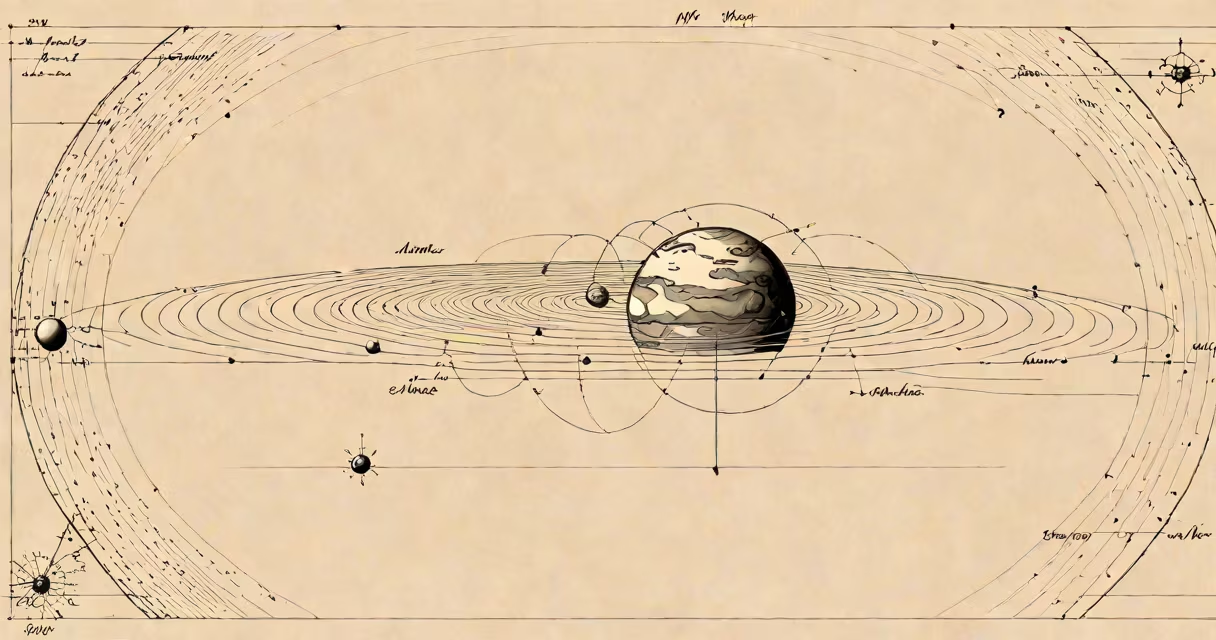
Mars distance from the Sun ranges between 128.4 million miles (206.6 million km) at perihelion and 154.8 million miles (249.2 million km) at aphelion, with an average of 141.6 million miles (227.9 million km). This variation stems from Mars's elliptical orbit, not a circular one.
The planet orbits the Sun once every 687 Earth days, completing roughly 1.88 Earth years per revolution. Its orbit lies outside Earth's, making Mars the fourth planet from the Sun. Because of this position, sunlight takes about 12 minutes and 40 seconds to reach Mars from the Sun-compared to 8 minutes and 20 seconds for Earth.
Astronomers measure distances in the solar system using astronomical units (AU). One AU equals Earth's average distance from the Sun-about 93 million miles. Mars averages 1.52 AU from the Sun, placing it firmly in the outer region of the inner planets.
Mars follows Kepler's laws of planetary motion. Its orbit is elliptical, meaning distance varies continuously. The closest point, perihelion, occurs when Mars crosses the line connecting the Sun and the planet's farthest point (aphelion).
At perihelion, Mars receives about 44% more solar energy than at aphelion. This variation influences seasonal extremes. Martian winters in the southern hemisphere are colder and longer because the planet moves slower near aphelion, extending winter duration.
For comparison, Earth's orbit is nearly circular, with a difference of only 3.4 million miles between closest and farthest points. Mars's orbit has a higher eccentricity-0.093-making its distance changes more pronounced.
Three key measurements define Mars's distance from the Sun:
| Measurement Type | Distance (miles) | Distance (km) | Distance (AU) |
|---|---|---|---|
| Perihelion (closest) | 128,400,000 | 206,600,000 | 1.13 |
| Average distance | 141,600,000 | 227,900,000 | 1.52 |
| Aphelion (farthest) | 154,800,000 | 249,200,000 | 1.67 |
These values are based on NASA's JPL Horizons system, which uses precise observational data and gravitational models. The differences aren't random-they result from gravitational interactions with Jupiter and other planets over time.
Scientists track these changes using radar ranging and spacecraft telemetry. Data from rovers like Perseverance and orbiters like MAVEN help refine orbital calculations. These tools detect subtle shifts caused by tidal forces and mass distribution in the solar system.
Distance affects mission planning. NASA's Mars rovers operate on solar power during daylight hours. When Mars is farther from the Sun, solar intensity drops, reducing energy available for operations. Engineers design systems to handle a 30% reduction in sunlight during aphelion.
Climate modeling depends on accurate distance data. Seasonal ice caps on Mars grow and shrink based on solar input. During southern summer, increased sunlight melts more polar ice than in northern summer, despite similar axial tilt. This asymmetry arises because Mars is closer to the Sun during southern summer.
For example, in 2020, Mars reached perihelion on February 12. At that time, surface temperatures near the equator rose to around 20°C (68°F) during peak daylight. By contrast, at aphelion in 2021, daytime highs dropped to 10°C (50°F) even at the equator.
Many assume Mars is always farther from the Sun than Earth. While true on average, Mars passes Earth in orbit every 26 months. During opposition-when Earth lies between Mars and the Sun-Mars appears closer in the sky, but its actual distance from the Sun remains unchanged.
Another error is treating "distance" as a single value. The term "Mars distance from the Sun" refers to a range, not a fixed number. Using the average value without context leads to errors in atmospheric modeling and mission timing.
Some confuse Mars's distance with its apparent brightness. Mars appears brightest during opposition, not when closest to the Sun. Brightness depends on both distance from Earth and illumination angle-not solar distance alone.
In 2018, I tracked Mars's position using a small telescope and star charts. Over six weeks, I recorded its movement against background stars. When Mars was near perihelion, it moved faster across the sky, confirming orbital mechanics predictions. The planet's angular size also increased slightly, consistent with reduced distance.
This observation aligns with data from the European Space Agency's Mars Express orbiter, which measures orbital parameters with millimeter precision using radio signals. The spacecraft's trajectory corrections rely on updated distance models derived from such observations.
Additional insight comes from the Jet Propulsion Laboratory's Solar System Dynamics website, which provides real-time orbital data for all major planets. These tools allow users to simulate planetary positions and calculate distances at any date.
Final note: Mars distance from the Sun is not static. It changes over centuries due to gravitational perturbations. Over 100,000 years, Mars's eccentricity cycles between 0.002 and 0.15, altering its long-term climate patterns.