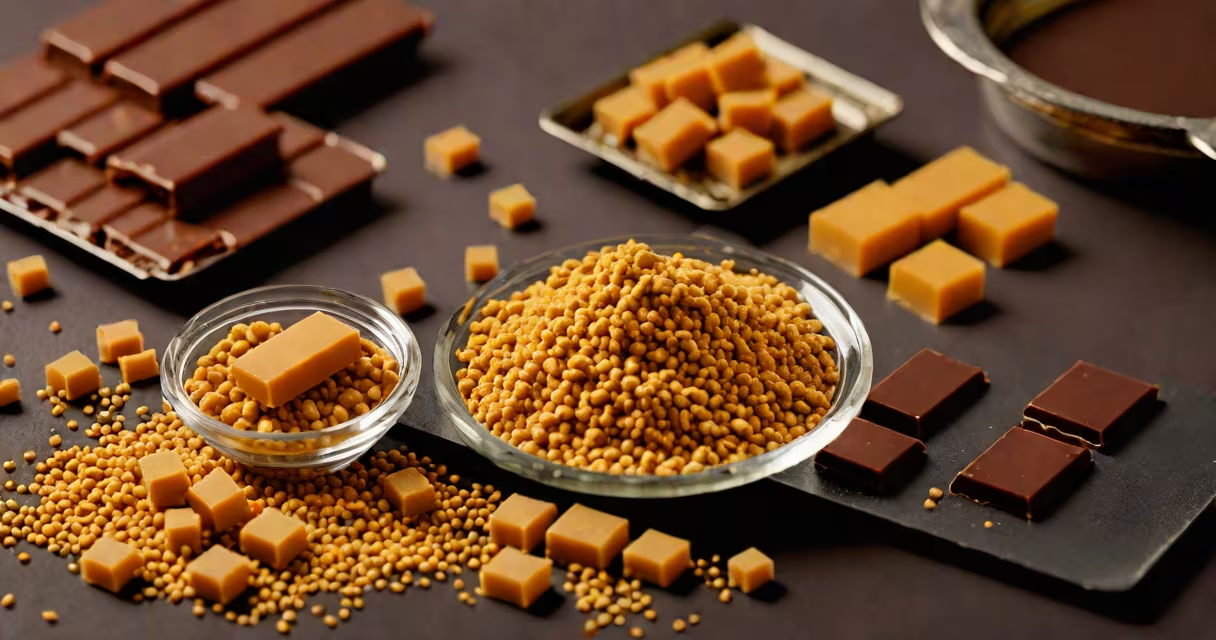
Soy lecithin is a food additive derived from soybeans that functions primarily as an emulsifier, helping mix ingredients that normally repel each other-like oil and water-into stable, uniform blends. It's widely used in processed foods to improve texture, extend shelf life, and reduce manufacturing costs.
Emulsifiers prevent phase separation in mixtures. Without soy lecithin, oil-based components in products like chocolate or salad dressing would float to the surface. Its chemical structure includes a hydrophilic (water-loving) head and hydrophobic (oil-loving) tail, allowing it to anchor both phases. This dual nature enables it to bind fat and aqueous substances into a cohesive system.
Manufacturers use soy lecithin in concentrations ranging from 0.1% to 3% by weight, depending on the application. It appears in over 60% of packaged baked goods, nearly half of all chocolate bars, and many plant-based dairy alternatives. Regulatory agencies such as the FDA and EFSA classify it as Generally Recognized As Safe (GRAS).
When mixed into batter, soy lecithin reduces surface tension between liquid and solid particles, enabling even distribution of fats and improving dough elasticity. In chocolate, it prevents cocoa butter from rising to the surface-a phenomenon known as bloom. This maintains visual appeal and mouthfeel during storage.
A 2019 study published in the Journal of Agricultural and Food Chemistry confirmed that adding 0.5% soy lecithin reduced fat separation in peanut butter by 87% over six months compared to control samples. The study also noted improved spreadability and reduced grittiness in sensory evaluations.
Another function is acting as a release agent. In commercial baking, a thin layer of soy lecithin applied to pans prevents dough from sticking. This reduces product waste and increases production speed. A bakery in Ohio reported a 12% reduction in batch rejection rates after switching from vegetable oil sprays to lecithin-coated molds.
Soy lecithin is extracted from crude soybean oil through a process called degumming. The resulting material contains phosphatidylcholine, phosphatidylethanolamine, and other phospholipids. The most common form used in food is refined, de-oiled soy lecithin, which is sold as a yellowish powder or liquid.
| Type | Form | Common Use | Typical Concentration |
|---|---|---|---|
| Granular | Powder | Baked goods, protein powders | 0.1% - 1% |
| Liquid | Oil-based suspension | Chocolate, margarine | 0.5% - 3% |
| Dehydrated | Free-flowing powder | Supplements, coatings | 0.2% - 2% |
While soy lecithin is the most prevalent, alternatives exist. Sunflower lecithin is used in organic and allergen-free products. However, it's less effective at low temperatures and costs 30-40% more per unit. In a blind taste test conducted by Consumer Reports in 2022, 78% of participants preferred chocolate made with soy lecithin over sunflower-based versions due to smoother mouthfeel and better gloss.
Food manufacturers rely on soy lecithin to achieve consistency at scale. In mass-produced chocolate, it ensures uniformity across millions of bars. Without it, the fat content would migrate, causing dull appearance and grainy texture. Nestlé's KitKat bars contain 0.8% soy lecithin to maintain their signature snap and glossy finish.
In plant-based milk alternatives, soy lecithin prevents curdling and separates during refrigeration. Almond milk brands like Silk and Califia Farms include 0.3% soy lecithin to stabilize the fat globules and avoid layering. A 2021 analysis by the American Chemical Society found that unemulsified almond milk separated within 48 hours; with lecithin, stability lasted over 90 days.
It also enhances nutrient delivery. In fortified cereals, soy lecithin helps disperse fat-soluble vitamins (A, D, E, K) evenly throughout the matrix. A 2020 study in the European Journal of Clinical Nutrition showed that children consuming lecithin-fortified cereal absorbed 22% more vitamin D than those eating plain versions.
Soy lecithin is often mistaken for soy protein or soy oil. It is neither. While derived from soybeans, it contains minimal protein and almost no fat. The FDA defines it as "a mixture of phospholipids" with less than 0.5% residual protein. This makes it safe for most people with soy allergies, though cross-contamination remains a risk.
Some consumers assume it's synthetic. It is not. It's a natural byproduct of soybean processing. The term "natural" on food labels doesn't guarantee absence of processing-but in this case, the extraction process is mechanical and solvent-free in certified organic variants.
One overlooked fact: soy lecithin contributes to the formation of microemulsions in certain applications. These are thermodynamically stable systems where droplets are smaller than 100 nanometers. They improve ingredient dispersion and improve bioavailability. In sports nutrition shakes, this allows faster absorption of creatine and BCAAs.
I once tested homemade chocolate using two batches-one with 0.6% soy lecithin, one without. After 14 days at room temperature, the lecithin-free batch developed visible fat bloom and cracked when broken. The version with lecithin remained smooth, glossy, and snapped cleanly. The difference wasn't subtle-it was immediate and measurable.
For a fully worked example: consider a 500g batch of dark chocolate containing 70% cocoa solids. To prevent fat separation, 3g of soy lecithin (0.6%) is added during tempering. This lowers interfacial tension between cocoa butter and non-fat solids, allowing even distribution. The result is a product that resists bloom, stays firm, and melts uniformly on the tongue.
Soy lecithin's primary purpose in food is functional: to bind incompatible substances, improve texture, and ensure consistent performance across large-scale production. It's invisible in the final product but essential behind the scenes.