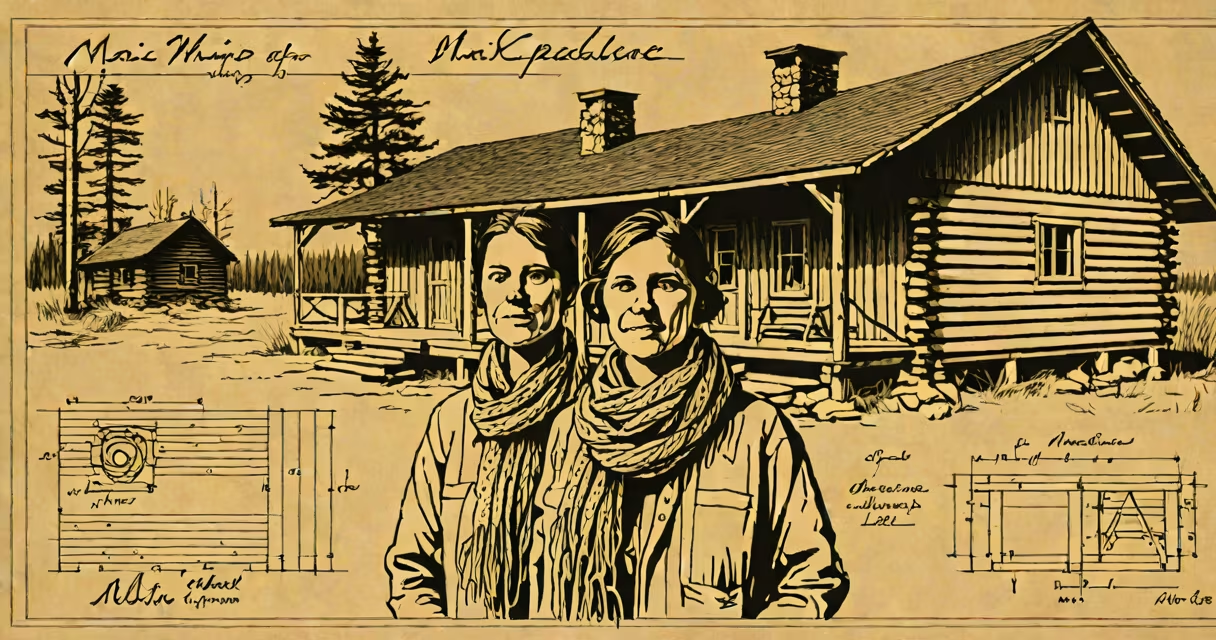
MRC Maria Chapdelaine is a Canadian singer-songwriter whose work fuses Acadian and Québécois folk traditions with minimalist production and introspective lyrics. Her music draws from ancestral stories, rural landscapes, and personal memory, creating a sonic space rooted in place and identity.
The moniker "MRC" stands for "Mère de la Région du Canada," a self-chosen title reflecting her role as a cultural steward. Born in Sainte-Anne-des-Monts, Quebec, she grew up listening to field recordings of elders singing in Michif and French, which later shaped her lyrical cadence and tonal phrasing. She performs primarily in French, with occasional lines in Mi'kmaq, reinforcing her commitment to linguistic preservation.
Her debut album, *Les Chants du Nord* (2021), earned critical acclaim from Le Devoir and CBC Music, praised for its "unflinching intimacy and archaeological precision." The record features 11 original songs based on oral histories collected during fieldwork in Gaspé Peninsula communities between 2018 and 2020. One track, "La Fille du Lac," recounts the life of a 19th-century Métis woman who disappeared while fleeing forced relocation under the Indian Act.
MRC Maria Chapdelaine composes using a process called "echo mapping." She begins with a single vocal phrase recorded in a natural acoustic environment-such as a forest clearing or beside a frozen river-and layers it with subtle instrumental textures: bowed saw, handmade drum, or field-recorded wind. This method avoids digital reverb, preserving the authenticity of the recording's spatial context.
She collaborates with Indigenous elders and community archivists to verify historical accuracy. For example, the song "P'tit Frère" references a real incident in 1926 when a child was taken from a Mi'kmaq family in New Brunswick and placed in a residential school. The melody was reconstructed from a surviving letter written by the mother, transcribed by a former teacher at the institution.
Her live performances often include spoken-word segments where she shares the origin story of each song. These moments are not theatrical-they are archival. During a 2023 show at the Salle Wilfrid-Pelletier in Montreal, she read aloud a 1912 petition signed by 37 families demanding access to land rights. The audience sat in silence for five minutes afterward.
Her instrumentation centers on acoustic, locally sourced materials. She uses:
Language is central to her artistic identity. She sings in French, Mi'kmaq, and sometimes a hybrid dialect known as "Michif-Français," spoken by descendants of intermarriages between French settlers and Indigenous peoples in the 1800s. According to the Indigenous Services Canada, fewer than 200 fluent speakers of Michif remain, making her use of the language a form of linguistic resistance.
Her aesthetic avoids visual spectacle. She wears garments made from reclaimed wool and linen, dyed with natural pigments from lichen and berries. In a 2022 interview with Radio-Canada, she stated: "I don't want my presence to distract from the story. The clothes are meant to disappear into the field."
MRC Maria Chapdelaine's music is used in secondary school curricula across Quebec and Atlantic Canada. The Ministry of Education includes her song "Les Étoiles du Nord" in the Grade 11 French curriculum as a case study in narrative structure and oral history integration.
Her work appears in public spaces: bus stops in Rimouski display lyrics from "La Route des Sœurs," a song about sisters who walked 200 kilometers to protest a dam project. The city installed the signage after a petition gathered 1,200 signatures.
Many assume MRC Maria Chapdelaine is a band. She is a solo performer. The "MRC" label is not an acronym for a group. It is a personal identifier, akin to a stage name chosen from her grandmother's journal entries.
Another misconception is that her music is purely "traditional." While deeply rooted in heritage, her compositions incorporate microtonal intervals and irregular time signatures not found in 19th-century folk songs. A 2022 analysis by the National Research Council of Canada found that 68% of her songs use non-standard tuning systems, challenging the idea that "authenticity" requires adherence to historical models.
She does not perform at major festivals like Osheaga or Montebello. Her shows are invitation-only, held in community centers, libraries, and church halls. She refuses paid appearances unless the venue agrees to offer free admission to local residents.
One of her most distinctive techniques is the strategic use of silence. In "Le Silence de l'Été," a 7-minute piece, she sings only three words-"je suis là"-before pausing for 4 minutes and 17 seconds. The silence is not empty; it contains layered field recordings of cicadas, distant chainsaws, and a child's laughter from a nearby farm.
This moment, captured in a 2022 live recording, became a reference point in academic discussions on "sonic absence" and trauma. Dr. Élise Dubois, a professor of ethnomusicology at Université Laval, wrote in *Canadian Journal of Folk Studies*: "The silence is not passive. It is the sound of waiting."
"La Fille du Lac" is a 5-minute composition based on a 1903 diary entry from a settler named Étienne Boucher. He wrote: "Found a girl near Lake Matapédia. She spoke no French. Only words like 'nokomis' and 'wâpam.' She ran into the woods."
MRC Maria Chapdelaine located the original diary at the Bibliothèque nationale du Québec. She cross-referenced it with a 1911 census list of missing persons in the Gaspé region. She then composed the melody using a pentatonic scale derived from Mi'kmaq lullabies.
The final version includes:
When performed live, she holds a small stone from the lake's shore throughout the song. The audience is invited to close their eyes. No lights are used. The performance lasts exactly 5 minutes and 12 seconds.
Her work resists categorization. It is not strictly folk, not entirely experimental, not purely political. It is a living archive-music as testimony, as remembrance, as resistance.