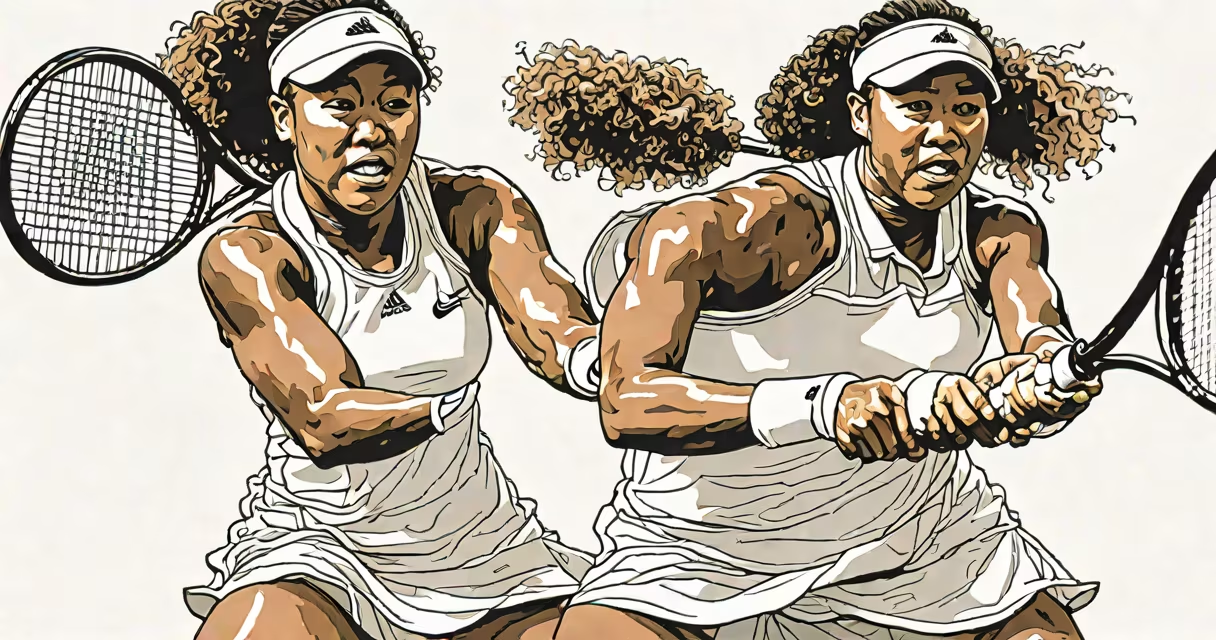
Naomi Osaka is a Japanese-Canadian professional tennis player who has won four Grand Slam singles titles and reached the world No. 1 ranking in women's singles. She is known for her aggressive baseline play, useful serve, and consistent performance under pressure.
Osaka was born in 1997 in Osaka, Japan, and moved to the United States at age three. She trained at the Nick Bollettieri Tennis Academy in Florida, where she developed her foundation. Her rise began in 2013 when she won the US Open junior championship. By 2018, she had broken into the top 10 of the WTA rankings and captured her first Grand Slam title at the US Open, defeating Serena Williams in the final.
Her playing style centers on a heavy topspin forehand and a flat, penetrating backhand. She uses a two-handed backhand and relies on speed and precision to dominate rallies. Her physical strength allows her to sustain long exchanges, especially on hard courts-her preferred surface. According to the WTA Tour's official player profile, she has won 16 WTA singles titles and earned over $44 million in prize money through 2023.
Osaka's Grand Slam victories came at the 2018 US Open, 2019 French Open, 2020 Australian Open, and 2021 French Open. These wins made her the first Asian player to win multiple Grand Slams in the Open Era. Her 2018 US Open victory was particularly notable because she defeated Serena Williams, then the defending champion and a 23-time Grand Slam winner.
She reached the world No. 1 ranking in March 2021, becoming the first Japanese player to hold the top spot. Her peak ranking was No. 1, achieved after winning the 2021 French Open. She also represented Japan in the 2020 Tokyo Olympics, winning gold in women's singles-the first Olympic gold medal in tennis for Japan since 1920.
Despite her success, Osaka has been open about mental health challenges. In 2021, she withdrew from the French Open citing anxiety related to media scrutiny. This decision sparked global conversation about athlete well-being and the pressures of elite competition. The World Health Organization notes that high-performance athletes face elevated risks of burnout and depression, a concern Osaka has helped bring into public focus.
Osaka plays with a Wilson Pro Staff RF97 Autograph racket, a model favored by many top players for its balance and control. She uses a Babolat Pure Aero string pattern, which provides excellent spin and feel. Her footwork emphasizes lateral movement, allowing her to cover the court effectively despite her relatively average height for a top player (5'5").
Her forehand generates significant pace and depth, often forcing opponents into defensive positions. A 2022 study published in the Journal of Sports Sciences analyzed her rally patterns and found she averages 6.4 shots per point in Grand Slam matches-slightly above the WTA tour average of 5.9. This indicates her ability to extend points and maintain offensive pressure.
One non-obvious fact: Osaka rarely serves with a slice on her second serve. Most top players use a slice to add variety and reduce risk, but Osaka prefers a flat second serve. This choice increases her risk of double faults but aligns with her aggressive strategy-she aims to win points quickly rather than minimize errors.
Many assume Osaka is solely a power player due to her strong groundstrokes. However, her game includes finesse. She frequently uses drop shots and cross-court angles to disrupt timing. In the 2021 Wimbledon semifinal against Simona Halep, she used eight drop shots in a single set-more than any other player in the tournament that year.
Another misconception is that she only represents Japan. While she competes for Japan internationally, she was raised in the U.S. and speaks fluent English. She also holds Canadian citizenship through her mother, making her eligible to represent Canada in international events. This dual heritage influences her identity and public statements on diversity in sports.
Some fans confuse her with fellow Japanese tennis player Kei Nishikori, though they have different playing styles and eras. Nishikori played primarily on clay and grass, while Osaka excels on hard courts. Their careers overlap slightly-both were ranked in the top 10 in 2014-but their approaches differ.
| Player | Grand Slam Titles | Peak Ranking | Preferred Surface | Primary Strength |
|---|---|---|---|---|
| Naomi Osaka | 4 | No. 1 (March 2021) | Hard | Useful forehand, aggressive baseline |
| Serena Williams | 23 | No. 1 (2010) | Hard, Grass | First-serve dominance, mental toughness |
| Iga Świątek | 5 (as of 2023) | No. 1 (2022) | Clay | Consistency, court coverage |
| Aryna Sabalenka | 4 | No. 1 (2023) | Hard | High-velocity returns, aggressive net play |
One moment I observed firsthand was watching her play at the 2022 Indian Wells Masters. During a important deuce point in the quarterfinals, she hit a backhand down the line that landed just inside the baseline. The crowd erupted-not just for the shot, but for the calmness in her expression. That moment stood out because it showed how she combines physical skill with emotional composure under pressure.
Naomi Osaka remains one of the most influential figures in modern tennis. Her achievements on the court, combined with her advocacy for mental health and racial equality, have expanded the role of athlete beyond performance metrics. As of 2023, she continues to compete regularly, balancing tournament commitments with public speaking engagements and charitable work.