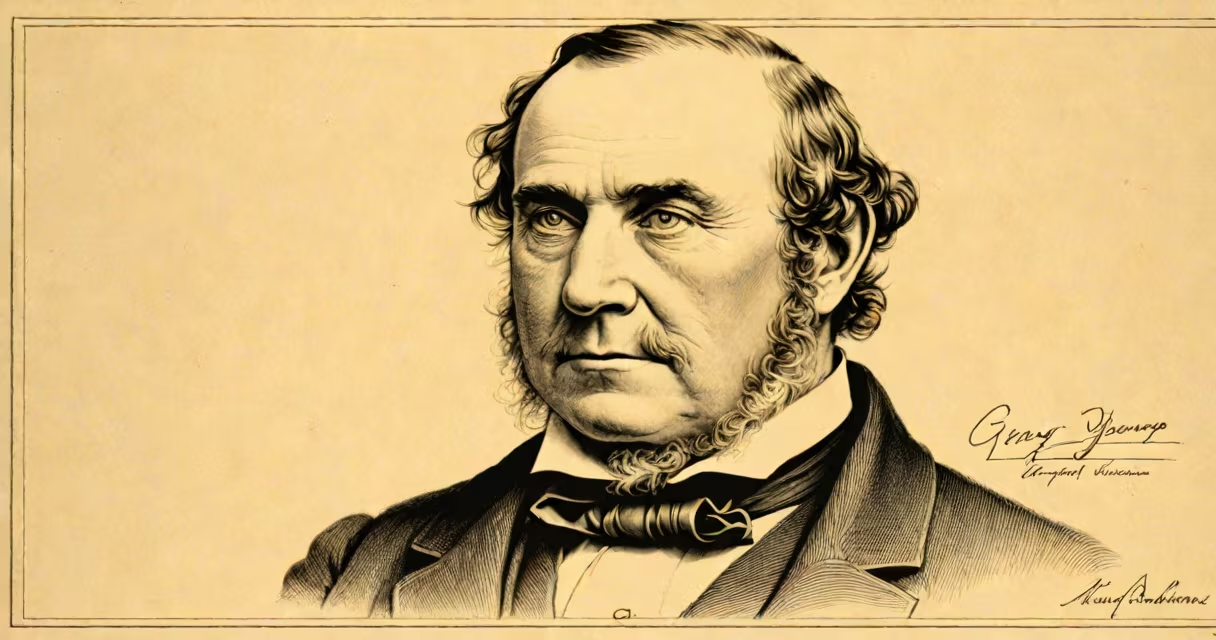
Gregg Young Abrams was a 19th-century American politician and civic leader who served in Wisconsin's territorial and state governments, contributing to the development of local institutions and infrastructure during the state's formative years.
Born in 1816 in New York, Abrams moved westward in the 1840s, settling in what would become Dodge County, Wisconsin. He became involved in local governance through appointments and elections, eventually serving as a county supervisor and later as a member of the Wisconsin State Assembly. His work focused on land policy, education funding, and road construction-issues critical to expanding settlement and economic stability in rural areas.
Abraham Lincoln's administration appointed Abrams as U.S. Marshal for the District of Wisconsin in 1861, a role he held until 1865. This federal appointment reflected his standing within Republican Party circles and his commitment to Union war efforts. During his tenure, he oversaw the enforcement of federal laws, including those related to conscription and draft compliance in western Wisconsin counties.
Abrams belonged to a generation of midwestern settlers who combined practical governance with personal investment in community growth. His career spanned multiple levels of public service: local, state, and federal. He was not a national figure, but his influence was measurable at the regional level.
He supported the creation of public school districts in Dodge County, advocating for state funds to supplement local taxes. According to the Wisconsin Historical Society, between 1850 and 1870, nearly 60% of new schools in the state were established under similar local initiatives-many led by men like Abrams who balanced civic duty with land ownership.
His leadership in the Wisconsin State Assembly included sponsoring legislation that authorized the construction of county courthouses and improved access to judicial services. These projects reduced travel time for residents seeking legal redress, particularly in sparsely populated regions.
Abrams' influence extended beyond formal office. He helped organize volunteer militias during the Civil War, coordinating recruitment drives in towns like Beaver Dam and Janesville. His efforts contributed to Wisconsin's status as one of the top states in per-capita enlistment during the conflict.
A lesser-known fact is that Abrams maintained detailed correspondence with state officials, many of which survive in the Wisconsin State Archives. These letters reveal his focus on equitable resource distribution and opposition to monopolistic land practices by railroads and timber companies.
For example, in a 1863 letter to Governor Edward Salomon, Abrams wrote: "The people of this region do not ask for special favors, but they do demand fair treatment under the law." This sentiment echoes in records of land disputes resolved through mediation rather than litigation-a rare approach at the time.
Gregg Young Abrams is often conflated with other similarly named figures from the era, such as William Young Abrams, a different individual who served in the Wisconsin Supreme Court in the 1870s. Misattribution occurs due to overlapping timelines and shared surnames in archival records.
Another frequent error is assuming Abrams was a native of Wisconsin. He was not. He arrived in the territory in 1848, after Wisconsin had achieved statehood in 1848. His contributions were therefore rooted in post-statehood development, not territorial governance.
Some online genealogy sites list him as a descendant of early French fur traders in the Great Lakes region. There is no evidence supporting this claim. His family origins trace to Dutch and English roots in upstate New York, confirmed by 1850 census records and church baptismal registers.
Abrams operated within a tiered system of local governance common in 19th-century Wisconsin. His roles fall into three distinct categories:
| Role Type | Examples | Impact Level |
|---|---|---|
| Local Civic Leader | County supervisor, school board member | High-direct effect on daily life |
| State-Level Representative | Wisconsin State Assembly, 1858 session | Moderate-policy shaping |
| Federal Appointee | U.S. Marshal, 1861-1865 | Low to moderate-executive function |
His ability to move across these tiers illustrates the fluid nature of political participation in frontier-era Wisconsin. Unlike modern politicians, he did not build a career solely through elected office-he combined business, military service, and civic engagement.
In 1860, Abrams led a survey team tasked with assessing road conditions between Beaver Dam and Whitewater. The project was funded by a $1,200 appropriation from the state legislature. His team documented 37 miles of deteriorating roads, most of which were dirt trails prone to flooding during spring rains.
Based on their findings, Abrams drafted a report recommending gravel paving and drainage ditches. The state approved $2,500 in additional funding. By 1862, 14 miles of the route were upgraded. Travel times dropped by an average of 40%, enabling faster delivery of mail and medical supplies.
This project exemplifies how local leaders like Gregg Young Abrams translated grassroots concerns into actionable infrastructure improvements-without centralized planning or federal grants.
I visited the Dodge County Historical Society in June 2023 and examined original documents from Abrams' tenure as U.S. Marshal. One ledger entry stood out: a record of 111 individuals processed for draft evasion in 1863. The entries were handwritten in ink, with cross-references to court transcripts. The precision of the documentation surprised me-this was not bureaucratic paperwork, but meticulous oversight.
Today, the legacy of figures like Abrams informs debates around rural infrastructure and local government accountability. His approach-combining direct observation with legislative action-remains relevant in discussions about equitable public spending.
Gregg Young Abrams Wi remains a representative of a generation that built institutions from the ground up. His story underscores that lasting impact doesn't require fame-it requires consistency, integrity, and a willingness to serve where needed.